
Snooker Spin: Follow, Screw and Stun Explained.
Potting the object ball gets you points. Controlling the white gives you a chance to score again. Start with simple straight shots and change one thing at a time so you can see what the cue ball does.
Start with a centre-ball shot
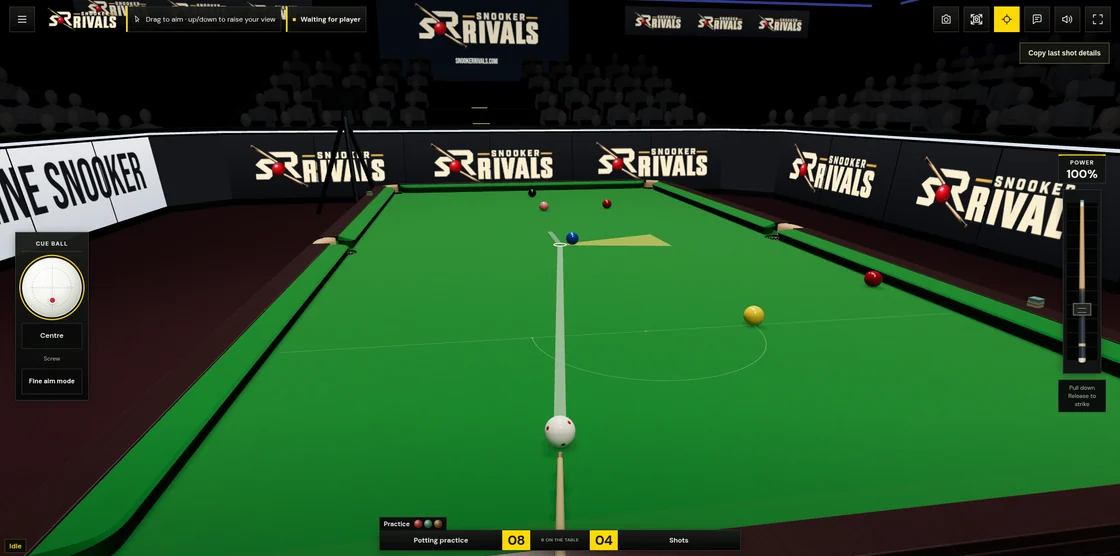
Set the contact marker near the centre of the white and use a moderate pace. Watch the white after it meets the object ball. A centre strike does not guarantee a stop shot: the distance travelled and the pace of the shot affect how much roll the cue ball has when it arrives.
Use the same object-ball position for several attempts. If you change the pot angle, pace and spin together, it is hard to tell which change produced the result.
Follow: let the white travel forward
Move the contact point above centre to apply topspin. In a straightforward full-ball example, the white can continue forward after contact. Try to finish it in a useful area rather than driving it as far as possible. A little forward movement may be enough to leave the next colour.
Practice: line up a comfortable straight pot. Play it three times at a similar pace, moving the marker a little higher on each attempt. Compare the finishing positions.
Screw: bring the white back
Move the marker below centre to apply backspin. If enough backspin remains at impact, the white can draw back after hitting the object ball. Over a longer distance, cloth friction can use up that backspin before contact. Power, distance and strike point work together.
Practice: begin with the white fairly close to a straight pot. Try a small amount of screw, then increase it gradually. Watch the route back as well as the pot: a successful draw shot can still leave the next shot awkward.
Stun: arrive without forward or backward roll
A stun shot reaches the object ball with the white sliding rather than rolling forward or spinning backwards. On a straight full-ball shot, that can stop the white near the contact point. On an angled shot, the cue ball moves away along a different line. This makes stun useful for positional play, but the result depends on the collision.
Practice: keep a straight pot fixed and adjust pace and a small amount of low contact until the white stops close to where it hits. Repeat from a different distance and notice that the same setting does not automatically give the same result.
Side spin: learn it after the basics
Moving the marker left or right adds side spin. It can change the response from a cushion and complicate position. Begin by comparing the same cushion shot with centre, left and right contact. Avoid adding side to every pot before you understand the forward and backward movement.
Using the controls in Snooker Rivals
The white-ball control selects the contact point. Pull the cue control down to build power and release to strike; move it back up before release to cancel. Reset the marker to centre when you want to remove your previous spin choice. Near a cushion, the game may raise the contact point to clear the rail.
Read How to play for desktop and touch controls. Start from Play to practise, or use a private table with a friend to compare shots. These examples explain the intended technique; the alpha simulation continues to be refined through testing.